
AI can test a lot, we test what matters
AI helps to support our testing activities, and we therefore make use of it wherever we can. This frees up our testers to focus on what really matters: value-based testing.
Together, we have more than 30 years of experience in the field of software testing. We focus on test management, test consulting, agile transformations, and training. As part of our projects, we conduct test workshops for our clients.


TTest management provides our clients with the right information to make informed decisions about the quality of their product at the right time.
We offer various test management approaches, including Session-Based Test Management (SBTM), and provide test consulting to both small and large companies.
SBTM involves testing in sessions with a clear test mission, a fixed timebox, and a post-test report. As a result, the client knows exactly what has been tested, what they know about the product’s quality, what is not yet known or tested, and what risks remain.
For us, test management goes beyond simply managing tests; we also consider the quality of test execution, the testers, the software, and the product’s design.

Our certified testers range from junior to senior levels. They receive guidance and further training throughout their careers, tailored to their l
How well has your product been tested?
A software product is a set of—often complex—relationships. Testing involves making choices about what makes sense to test within the context we are examining.
During our analysis, we use the DeV-CRAQ model, which we developed ourselves, to gain insight into:
For our testing approach, we then use test coverage models at three levels:
Our testers, ranging from junior to senior levels, apply this approach in the context of a specific product and based on the associated risks. Our approach is investigative and critical, and we actively contribute to ensuring the quality of a product. Where necessary and appropriate, we support our work through test automation and AI applications.
When an organization adopts an agile approach, the role of testing also changes. Testing is no longer a separate phase at the end of the process, but rather an integral part of the entire team’s work, from refinement to release. We help organizations embed testing and a quality-first mindset into their agile approach: from test strategy and regression testing to acceptance criteria, Definition of Done, and the tester’s role within the team. Because every organization is different, we first assess your context and work with you to choose the approach that best fits your needs.
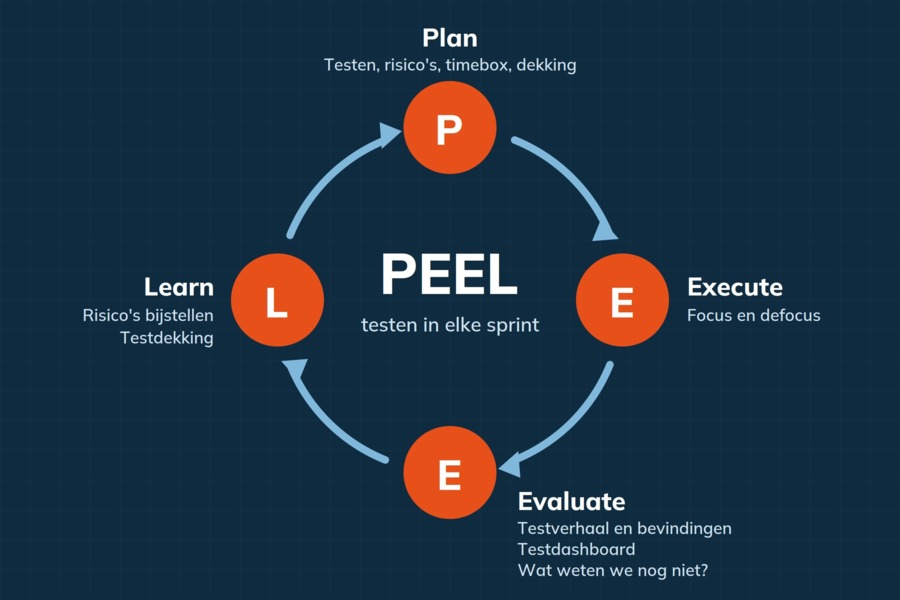
We have developed the PEEL method based on Deming’s PDSA cycle. PEEL stands for: Plan, Execute, Evaluate, and Learn. PEEL is applied to all testing activities, making testing a structured activity organized within specific timeframes.

We offer training sessions, courses, and workshops on testing and agile methodologies led by experts in the field. These are always tailored to your needs and are conducted in both Dutch and English.